
Learn About Nicaragua
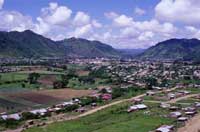
A scenic view of some of Nicaragua's farmland
Nicaragua is the largest country in area in Central America. It takes its name from Nicarao, who was an Indian chief in the region when the first Spanish colonists arrived in the 1500s. Nicaragua lies between two great bodies of water — the Pacific Ocean and the Caribbean Sea, an arm of the Atlantic Ocean. It is a land of forests, large lakes, rivers, and rugged mountains, many of which are active volcanoes. It is also a land that has known little peace. Dictatorships, foreign intervention, and civil wars have marked much of its history.


The Land. There are three distinct landforms in Nicaragua — the Mosquito Coast, the highlands, and the Nicaraguan lowlands. The Mosquito Coast lies along the Caribbean Sea. It is a wide, flat plain with many swamps and tropical forests. The coastline is dotted with bays, lagoons, and sandy beaches. The highlands form the backbone of Nicaragua. Two mountain ranges run down the center of the country, reaching altitudes of up to 6,560 feet (2,000 meters). The higher mountains are in the north. The lower ranges lie farther south. The fertile highlands contain lush forests as well as most of the minerals found in Nicaragua.
The Nicaraguan lowlands stretch along the Pacific coast and slant across the country to the valley of the San Juan River and the Caribbean Sea. In the northwest the lowland region is bordered by a string of more than 20 volcanoes and many of them are still active. Volcanic ash has made the soil very fertile. The lowlands have numerous river valleys and two large lakes called, Nicaragua and Managua.
Lake Nicaragua is one of the largest bodies of fresh water in the Americas. It is the only inland lake in the world in which there are sharks. Lake Nicaragua is linked to the smaller Lake Managua by the Tipitapa River, and to the Caribbean Sea by the San Juan River. This region of lakes and rivers has long been considered a possible site for a canal across Nicaragua.
Climate. Nicaragua's climate is tropical. It is hot and humid, with temperatures averaging about 80°F (27°C) all year-round. The Mosquito Coast is the wettest place in Central America. It receives an average of about 100 inches (2,500 millimeters) of rainfall a year.
Nicaragua's most important natural resources are its fertile soil, its forests, and its mineral deposits. Among Central American countries, Nicaragua is second only to Honduras in its mineral resources, with gold being the most important mineral export.
The Economy
Nicaragua's economy is based largely on agriculture and cattle raising. Coffee, cotton, sugarcane, and bananas are the leading commercial crops. The most important food crops are beans, corn, rice, and sorghum. Nicaragua is the leading cattle-raising country in Central America. Much of the cattle grazing is carried out on the Mosquito Coast.
Nicaragua is still covered with vast areas of forest. The rain forests of the Mosquito Coast yield such valuable woods as mahogany and rosewood. Still, Nicaragua's economy has suffered severely from the civil wars that have long racked the country.
History and Government
Christopher Columbus landed in Nicaragua in 1502, during his fourth and last voyage of exploration to the Americas. Spanish colonization began soon after, and Spanish rule lasted for nearly 300 years.
Independence. Nicaragua and the other Spanish colonies in Central America declared their independence in 1821. After briefly joining with Mexico, they formed their own federation, the United Provinces of Central America. But political rivalries soon broke up the federation, and Nicaragua became an independent republic in 1838. After independence, two political groups, the Liberals and Conservatives, struggled for control of the country. In 1855, William Walker, an American, was invited to Nicaragua by the Liberals. Helped by U.S. business leaders, Walker made himself president of Nicaragua. Walker soon lost support, however, and was driven out of the country. Although Walker had acted without encouragement from the U.S. government, Nicaraguans felt his actions showed the desire of the United States to dominate their country. During this period, Managua was chosen as the nation's capital.
Conservative Rule. In 1863 the Conservatives came to power and ruled for thirty years, although the struggle between the two parties continued. For many years the United States had been interested in building a canal across Nicaragua, linking the Atlantic and Pacific oceans. This made Nicaragua important to the United States. (A canal eventually was built across Panama.) In 1912, U.S. Marines were sent to Nicaragua to put down a revolt and protect U.S. interests. In 1928 a Liberal leader, Augusto César Sandino, began a guerrilla war against the U.S. presence in Nicaragua.
The Somozas. In 1933, the U.S. Marines withdrew, leaving behind a legally elected government and a National Guard, trained by the United States, to maintain peace. But once the U.S. forces left, the commander of the National Guard, Anastasio Somoza Garcia, used the guard to seize control of the country. Sandino was killed in 1934, and in 1936, Somoza was elected president after the previous president resigned and fled the country. Somoza restored peace but he banned political opposition and was criticized for governing for his own profit. Somoza was assassinated in 1956 and was succeeded by his son Luis Somoza Debayle. Anastasio Somoza Debayle, a brother of Luis, became president in 1967. Like other members of his family, he acquired great wealth from his office. Opposition to his rule led to the outbreak of civil war in 1978. The anti-Somoza rebels were called Sandinistas, after the guerrilla hero Sandino. The war destroyed cities and industries, and made it impossible to plant or harvest crops. Somoza resigned in 1979 and was later assassinated.
The Sandinista Government. The victorious Sandinistas formed a government led by a junta (council). They were able to bring much of the country's economic activity under government control. Some praised the Sandinistas' efforts for beginning programs that improved health care encouraged the redistribution of land. They also began programs that taught peasants to read. But, others disagreed and noticed the collectivization of agriculture and seizure of businesses. They charged that the Sandinistas employed Communist methods, which hampered the country's economic growth and restricted civil liberties.
The Sandinistas greatly expanded the army and obtained large quantities of tanks and helicopters from the Soviet Union. Nicaragua now had a larger army than any of its neighbors. Other Central American nations became alarmed and accused Nicaragua of aiding leftist rebels in neighboring El Salvador. Nicaragua itself felt threatened by the United States. In the 1980s a new civil war broke out between the Sandinistas and opponents of the government, called contras, who were aided by the United States. Elections in 1984 installed Daniel Ortega Saavedra, a Sandinista commander, as president. This failed to improve the situation, as opponents charged that the Sandinistas had controlled the campaign and the election. A new constitution in 1987 set 6-year terms for the president and the legislature, the National Assembly. Meanwhile, Nicaragua's economy remained in crisis, due to contra attacks, shortages of goods caused by the expense of the huge army, and mismanagement. Inflation reached an incredible 36,000 percent in 1989. The Sandinistas blamed a trade embargo by the United States.
Regional Peace Accord. An agreement signed by Ortega and four other Central American presidents in August 1987 led to new elections in Nicaragua in 1990 under United Nations supervision. Violeta Barrios de Chamorro led the United Opposition (UNO), a group of 14 political parties, in defeating Ortega. The U.S. embargo was then lifted and the contras were disbanded.
The Chamorro government faced the difficult task of rebuilding the country. Peace was restored, but not prosperity, so Chamorro was denied the chance to run for a second term. She was succeeded in 1996 by José Arnoldo Aleman Lacayo. In 1998, during his term in office, Nicaragua was devastated by Hurricane Mitch. In 2001, Ortega made another bid for the presidency but was soundly defeated by Enrique Bolaños Geyer. The following year, Bolaños was accused of electoral fraud for financing his campaign with foreign money, a practice prohibited by the constitution.
 Reviewed by Kenneth J. Grieb
University of Wisconsin — Oshkosh
Editor, Central America in the Nineteenth and Twentieth Centuries: An Annotated Bibliography
|
Learn more about Nicaragua in these selected Web sites:
This page includes links outside of Scholastic.com.
Every Web site we link to was visited by our team at one point in time to make sure it's appropriate for children. But we do not monitor or control these sites, and these sites can change. In addition, many of these sites may have links to other sites that we have not reviewed. Be sure to get permission from your parents or teacher before leaving this site, and remember to read the Privacy Policy and Terms of Use of any site you visit.
World of Sharks
http://www.pbs.org/wgbh/nova/sharks/world/
Learn everything you ever wanted to know about the world of sharks.
Volcanoes
http://www.edicioneslupita.com/paseo/volcani.html
Learn about Nicaragua's impressive volcanoes. Visit this site to find out how long it takes to climb the largest volcano in Nicaragua.
Lake Nicaragua
http://www.edicioneslupita.com/paseo/lagoi.html
Learn why Nicaraguan's call this lake the "sweet sea".
Maps of Nicaragua
http://www.lib.utexas.edu/maps/americas/nicaragua.gif
http://bbfi-northamerica.org/Weed/maps/weedmaps.html
Nicaraguan Baseball Player, Vicente Padilla
http://www.mlb.com/NASApp/mlb/phi/team/phi_player_bio.jsp?club_context=phi&playerid=218894
Learn about Vicente Padilla, a major league baseball pitcher for the Philadelphia Phillies.
