

Meet the People
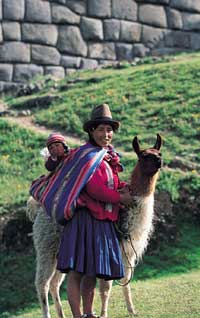
A woman dressed in the local, colorful colors, and carrying a baby on her back stands next to a llama.
Most Peruvians are either descendants of the Incas and other Indian people or are mestizos, persons of mixed Indian and Spanish ancestry. About 10 to 15 percent of the people are of pure Spanish origin. The remainder of the population includes descendants of black African slaves who intermarried with Peruvians, and immigrants from China, Japan, Italy, Germany, and Britain.

 <
<

The most widely spoken languages in Peru are Spanish and the Indian languages Quechua and Aymará. Spanish and Quechua are the country's official languages. Mestizos generally speak Spanish, though they may speak Indian languages as well. Most of the people are Roman Catholics.
Education is compulsory for all Peruvian children between the ages of 7 and 16. Almost all towns and villages have primary schools, but high schools and colleges are found mainly in the large cities. The National University of San Marcos in Lima, the capital, was founded in 1551 and is one of the oldest universities in the Americas.
Way of Life
Life in Peru varies widely from region to region. The geography of the country divides it into several distinct regions, and the different cultural backgrounds of the people often determine where and how they live. The whites and some mestizos live in the coastal cities. Most of the Indians inhabit the highlands of the Andes and the rain forests of the Amazon River basin in the interior.
Life in the Andean Highlands. Closely-knit families are the basic work and social groups of the highland people, who are called serranos. Farm families work together in the fields, and children take care of the animals. Children in highland towns also often help their parents. Almost all highlanders raise chickens, ducks, turkeys, and cuyes (guinea pigs) in their backyards. And picante de cuy (guinea pig with potatoes and pepper sauce) is a favorite highland food. Other popular dishes include thick vegetable and cereal soups, mutton, potatoes, and home-baked bread.
The Indian people of the highlands live in small villages. They grow a variety of crops for their own use and raise livestock. The native Andean llamas, animals belonging to the camel family, are used for meat and as beasts of burden in southern Peru. A related animal, the alpaca, is also bred at high altitudes. The Indians spin and weave sheep and alpaca wool into beautiful ponchos and other clothing. The hard-working Indian farmers have chewed coca leaves for thousands of years. It was long thought that this was a bad habit. But recent studies show that chewing this leaf aids digestion and helps people adapt to high altitudes.
Mestizo highlanders live in the towns, where they work as storekeepers, teachers, government officials, and technicians. They tend to be wealthier than the Indians, and they often employ Indians as servants or laborers. The Indians who work in the towns often learn Spanish and begin to adopt mestizo ways. They may stop chewing coca leaves, for example, or cease wearing traditional homespun wool clothing. People who alter their Indian culture in this way are usually called cholos.
Highland life has many problems. Most of the people are poor, and the Indians have often been exploited. But education and increased contact with the outside world are bringing change to the highlands.
Life in the Amazon Region. The eastern slopes of the Andes and the interior lowland are part of the huge basin of the Amazon River. Only 12 percent of the people live in this vast area. About 50 different Indian tribes — such as the Campas, the Shipibos, and the Aguarunas — live in small villages near the rivers and lakes. There they farm, hunt, and catch fish. The Indian peoples of this region have lived in this way for thousands of years. The government has built airports and roads to encourage the development of the remote Amazon frontier. The Indian way of life is changing rapidly as the Indians come into closer contact with other Peruvians. For most Indians, change has created serious economic and social problems.
Paul L. Doughty
Author, Peru: A Cultural History
|
