 |
 |
 |
 |
 |
 |
 |
 |
 |
 |
|
|
|
||||||||||||||||||||
 |

|
||||||||||||||||||||||
|
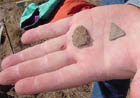
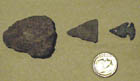
Yesterday we found some projectile points at the site. When we think of arrowheads, most of us think of Native Americans, but all of us had ancestors who made and used stone tools. You might be surprised to know that the sharp edge of a flake (a sharpened stone) is much sharper than anything we've been able to produce up until the time of the laser. Rocks are shaped into stone tools by striking them with another rock, or with a hammer made of wood or antler. Karl showed us how to do this last night using obsidian, which is a glassy volcanic rock. The best rocks for making sharp tools have a lot of silica (glass) in them. There were many types of rock like this available to the ancient Pueblo people. In Monticello Canyon, rhyolite, chert, and chalcedony were used. Projectile points and stone tools, like pottery, can give archaeologists clues about who lived at the site and when. During different time periods, projectile points were made in different styles, which archaeologists have identified. The archaeologist considers the stone tool and the other artifacts found in the same area — like the potsherds and charcoal — to help determine the age of the site. The two stone tools in my hand — a bi-face (left) and a projectile point (right) are much older than the other artifacts found in the unit. What does this time difference suggest? Were the tools left by people who lived here during an earlier period? Or were they found and picked up by later inhabitants and then left at the site? Sometimes archaeology generates more questions than answers! Credits: Courtesy of Shayne Russell |
||||||||||||||||||||||

 |
|
 |
||||