Scholastic Professional
Books & More
Scholastic Professional offers a robust selection of titles and professional tools that will help you overcome the challenges that you face in the classroom every day. Our publishing list includes an expansive selection of Teaching Strategy books on a variety of topics including Fluency for struggling learners, positive teacher talk, the craft of writing, and strategies for ELL students.
Featured New Releases from Scholastic Professional
Hoyt and Therriault, Mastering the Mechanics
» Buy All Three Grade Levels Now
Mastering the Mechanics
Linda Hoyt and Teresa Therriault
Grades K-5
At last, a collection of smart, breakthrough lessons that help you teach your students all the essential editing skills they need to create successful, polished writing. Each grade level specific book features a Year Long Planner that helps you chart your instruction across the school year, an indispensable Skills Continuum that identifies the skills your students should know at each grade level, and a years-worth of smart, easy-to-use lessons that focus on grammar, spelling, punctuation, and the use of conventions in writing.
Bergen, Teaching Writing in Kindergarten
» Buy Now
Teaching Writing in Kindergarten
Randee Bergen
Grades K
This smart, simple approach ensures that kindergarteners write at or above a first-grade level by the end of the year. Master teacher Randee Bergen shares her yearlong plan for daily writing, providing complete lessons and tips for motivating all learners, managing writing time, and assessing children's work effectively and efficiently.
Burke, Effective Instruction
» Buy Now
The Teacher's Essential Guide Series: Effective Instruction
Jim Burke
Grades 6-12
For the busy teacher on-the-run, veteran teacher Jim Burke has created The Teacher's Essential Guide series, a collection of slender, quick-read guides that offers you targeted solutions to your most pressing instructional needs. Effective Instruction will help you zone in on the essentials that really matter, streamlining and simplifying your teaching while boosting student engagement and achievement.
White, Assessment First
» Buy Now
Assessment First
Deborah White
Grades 1-5
“To maximize the impact of your teaching, follow the assess-plan-teach model,” teachers are told, yet they receive little support in putting this model into action. Finally, here is an indispensable guide that explains how to make every minute of primary reading instruction count-starting with assessment.
Lane, But How Do You Teach Writing?
» Buy Now
But How Do You Teach Writing?
Barry Lane
Grades K-12
Packed with practical ideas teachers and students can try instantly and experience immediate success with writing. The book is divided into three parts: Out of the Gate contains easy ideas to help you get started, More Reasons to Write shows you how to teach across genre, both fiction and nonfiction writing, and Refining Writing addresses everything you need to know about revision, grammar, punctuation, and assessment.
Gentry, Step-by-Step Assessment Guide to Code Breaking
» Buy Now
Step-by-Step Assessment Guide to Code Breaking
J. Richard Gentry
Grades PreK-2
A classroom-based, child-centered assessment for tracking step-by-step progress in reading, writing, and spelling with reproducible assessment forms. Drawing on major new insights in brain research, Gentry shows how reading and writing develop in five phases—children progress from no knowledge of the alphabet to an understanding of phonics chunks—providing a blueprint for instruction.
Robb, Teaching Reading: A Differentiated Approach
» Buy Now
Teaching Reading: A Differentiated Approach
Laura Robb
Grades 4 & Up
This 3-ring binder from reading expert Laura Robb is the comprehensive resource for research-based reading instruction. In it, Robb has compiled classroom-tested lessons and strategies that help students activate prior knowledge, monitor comprehension, make inferences, write in response to fiction and nonfiction texts, and so much more.
Sloan, Teaching Young Writers to Elaborate
» Buy Now
Teaching Young Writers to Elaborate
Megan S. Sloan
Grades 1-3
Even very young children can learn a repertoire of elaboration techniques to take their writing from bland to exciting. In this resource, a veteran teacher shares the mini-lessons and strategies she created to teach children how to develop their writing by adding definitions, asking questions, using visualizations, and lots more.
Akhavan, The Content-Rich Reading & Writing Workshop
» Buy Now
The Content-Rich Reading & Writing Workshop
Nancy Akhavan
Grades 4-8
How do you help your students hit the high achievement mark they face these days, keep them engaged in their studies, and fit everything you are expected to teach into a typical school day? The answer is simple and easy to implement: teach content and reading and writing strategies together. By teaching reading and writing through content and by folding rich content into your reading and writing instruction, not only do you create more powerful and exciting learning experiences for your students - helping them learn more - you save time and become a more efficient and effective teacher.
Culham, Using Picture Books to Teach Writing With the Traits: K–2
» Buy Now
Using Picture Books to Teach Writing With the Traits: K–2
Ruth Culham and Raymond Coutu
Grades K-2
Good teachers have long recognized the power of using picture books as models of good writing. The short, focused, and tightly woven text mirrors the kind of writing they want their students to be doing. In this essential resource, the authors have organized by trait more than 150 annotations of new and classic books that will delight young students—and inspire powerful writing. Peppered throughout are 18 step-by-step, trait-focused lessons based on specific books.
Schiffer-Danoff, Easy Ways to Reach & Teach English Language Learners
» Buy Now
Easy Ways to Reach & Teach English Language Learners
Valerie Schiffer-Danoff
Grades K-5
How can we help English Language Learners adapt and adjust to life in the classroom—and thrive? ELL specialist Valerie Schiffer-Dannoff shares her success strategies for including ELLs in meaningful instruction and classroom life right from the start.
Campo-Stallone, Literacy Centers in Photographs
» Buy Now
Literacy Centers in Photographs
Nikki Campo-Stallone
Grades K-2
This unique resource is packed with full-color photographs to show you how to make your literacy centers the best they can be. The photographs make it easy to understand how to set up and organize centers for poetry, listening, writing, independent reading, the ABCs, and lots more.
Alston, Why We Teach
» Buy Now
Why We Teach
Linda Alston
Grades K-12
Award-winning teacher Linda Alston strives to help educators generate their own joy, passion, creativity, and love of their profession. The readers will find peace and inspiration as Alston helps them realize what a difference their teaching makes for children and their families. Each chapter includes a remarkable story from the author's classroom, a brief reflection on its significance, and an affirmation that others can use to transform their own teaching and the lives of their student.
Sibberson and Szymusiak, Day-to-Day Assessment in the Reading Workshop
» Buy Now
Day-to-Day Assessment in the Reading Workshop
Franki Sibberson and Karen Szymusiak
Grades 3-6
In this book, two seasoned teachers show how to set reading goals, assess students to ensure goals are being met, and carry out instruction. Stressing that there are many ways to determine where students are and just as many ways to determine where to take them, they give teachers the tools to make that journey.
Culham, Inside the Writing Traits Classroom
» Buy Now
Inside the Writing Traits Classroom
Ruth Culham
Grades K-2
In these exciting lessons, primary students embrace the traits to improve their writing. Watch as master teachers break down writing so students know what to do and how to do it-how to use a writer's notebook to find ideas… how to use their “speaking voices” to discover their “writing voices”… how to use fine literature to inspire word choice and sentence fluency… and more.
Scott, Skobel, and Wells, The Word-Conscious Classroom
» Buy Now
The Word-Conscious Classroom
Judith A. Scott, Bonnie J. Skobel, and Jan Wells
Grades 2-6
Want to guarantee that students are learning rich vocabulary all day, everyday—and, by doing this, improving their reading and writing? In this lively, research-based book, based on successful classroom practice, the authors offer dozens of strategies, mini-lessons, units , and activities that increase students' exposure to and appreciation of sophisticated language.
Rasinski and Padak, 3-Minute Reading Assessments
» Buy Now
3-Minute Reading Assessments: A Professional Development DVD and Study Guide
Timothy V. Rasinski and Nancy Padak
Grades 1-8
Reading experts, Tim Rasinski and Nancy Padak, developed powerful assessments that help you accurately identify students' potential reading problems in just three minutes. This exciting new DVD lets you observe teachers as they assess students in word recognition, comprehension, fluency, and vocabulary.
Madden and Sullivan, Teaching Fluency Beyond the Primary Grades
» Buy Now
Teaching Fluency Beyond the Primary Grades
Midge Madden and Jane Sullivan
Grades 4-8
Tougher vocabulary. Richly detailed descriptions. Sophisticated syntax. As texts become more challenging in the upper elementary grades, the fluency skills readers need become increasingly critical. Midge Madden and Jane Sullivan deliver classroom-tested lessons that help grades 4–6 readers achieve accurate, well-paced, expressive oral reading with all kinds of texts.
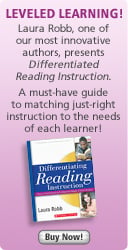
Robb, Differentiated Reading Instruction
» Buy Now
Differentiated Reading Instruction
Laura Robb
Grades 5 & Up
Differentiated instruction—matching just-right instruction to the needs of each learner—is a powerful and effective way to help all students be successful. In this resource, reading expert, Laura Robb, invites you into her classroom so you can see differentiated reading instruction in action.
Mack, Teaching Grammar With Perfect Poems for Middle School
» Buy Now
Teaching Grammar With Perfect Poems for Middle School
Nancy Mack
Grades 6-8
Ten reproducible poems that have middle-school appeal are paired with complete lessons to target key grammar concepts—predicate adjectives, direct objects, gerunds, clauses, compound sentences, and more. Nancy Mack's lessons provide a scaffold for students to grasp each concept and then use it skillfully in their own writing. Includes lively student models, literature links, and step-by-step publishing activities that help embed grammar instruction within the context of real writing.
Burke, The Teacher’s Essential Guide Series: Classroom Management
» Buy Now
The Teacher’s Essential Guide Series: Classroom Management
Jim Burke
Grades 6-12
This first in a series of essential guides for teachers offers classroom teachers concise, effective solutions to the most common instructional challenges they face. These solutions are based on a combination of research and the author's own experience as a public school teacher.
Allyn, The Complete Four for Literacy
» Buy Now
The Complete 4 for Literacy
Pam Allyn
Grades K–5
This book provides an organizational framework, detailed models, lessons and practical support for mapping and building grade-specific curriculum across the school year.
Samway, Taylor, Teaching English Language Learners
» Buy Now
Teaching English Language Learners
Katharine Davies Samway; Dorothy Taylor
Grades K–5
This book provides situations and issues that teachers may encounter when working with ELLs, and offers grade-level appropriate solutions, teaching approaches, and activities to address them.
McGee, Transforming Literacy in Preschool
» Buy Now
Transforming Literacy Practices in Preschool
Lea M. McGee
Grades Pre–K
When preschool children receive high-quality literacy instruction, it benefits their emotional and cognitive development enormously. But what does “high-quality literacy instruction” look like? In this research-based, yet practical resource, Lea McGee answers this important question.
Lewis, Robb, Poems for Teaching Content Areas
» Buy Now
Poems for Teaching in the Content Areas
J. Patrick Lewis; Laura Robb
Grades 4 & Up
75 poems perfectly pitched to the needs of teachers, along with simple, unique ideas for maximizing their teaching power before, during, and after learning.
Southall, Differentiated Learning Centers
» Buy Now
Differentiated Literacy Centers
Margo Southall
Grades K–3
In this comprehensive resource, veteran teacher and staff developer Margo Southall shares management tools along with hundreds of leveled activities that she has fine-tuned over the years.
Opitz, Don’t Speed. Read!
» Buy Now
Don't Speed. Read!
Michael F. Opitz
Grades K–5
The book equips teachers to make reliable professional judgments about students' fluency and provides a step-by-step plan with an array of instructional options.
Crawford, Krashen, ELL in American Classrooms
» Buy Now
English Learners in American Classrooms: 101 Questions, 101 Answers
James Crawford; Stephen Krashen
Grades K–12
With increasing numbers of ELLs posing unique challenges and opportunities for schools, the authors address educators' concerns in a concise and accessible way.
Fuhler, Walther, Literature is Back!
» Buy Now
Literature Is Back!
Carol J. Fuhler; Maria P. Walther
Grades 1–5
Organized by genre (picture books, traditional literature, modern fantasy, historical fiction, realistic fiction, poetry, and nonfiction), this book places quality children's literature at the heart of literacy teaching.
Dymock, Nicholson, Teaching Text Structures
» Buy Now
Teaching Text Structures: A Key to Nonfiction Reading Success
Sue Dymock; Tom Nicholson
Grades PreK–3
Two professors share their research-based, field-tested approach for helping students identify and analyze the most common expository text structures in order to better comprehend the nonfiction they read.
Gentry, Breakthrough in Beginning Reading and Writing
» Buy Now
Breakthrough in Beginning Reading & Writing
Richard Gentry
Grades PreK–3
Drawing on major new insights in brain research, Gentry shows how reading and writing develop in five phases-from operations with no letter knowledge to understanding of phonics chunks- that provide the blueprint for instructional approaches.
Strayer, Strategies for Differentiating in the Content Areas
»
Buy Now
Strategies for Differentiating in the Content Areas
Beverly Strayer; Troy Strayer
Grades 5 & Up
A master teacher-administrator team show how middle school teachers in ALL subject areas can reach ALL learners. Strayer and Strayer present eight surefire strategies teachers can use to a) provide assignment choices that motivate different kinds of learners and b) teach all students the content they need to know.
Smith and Wilhelm, Getting it Right
» Buy Now
Getting It Right: Fresh Approaches to Teaching Grammar, Usage, and Correctness
Michael W. Smith; Jeffrey Wilhelm
Grades 4 & Up
The authors consider what grammatical concepts and correctness issues are most worth teaching and how to teach those concepts and issues deeply.
Rasinski and Padak, Principal’s Guide to Literacy
» Buy Now
The Principal's Guide to Literacy in the Elementary Classroom
Autumn Tooms; Timothy Rasinski; Nancy Padak
Grades K – 6
Many principals are excellent leaders and managers, but feel less confident about their roles as curriculum leaders. This essential guide will help them with the most important area of learning that takes place in a school: literacy. Foreword by Gay Fawcett.
Robb, Principal’s Leadership Sourcebook
» Buy Now
The Principal's Leadership Sourcebook: Practices, Tools, and Strategies for Building a Thriving
Evan Robb
Grades 4 – 12
A principal who is an effective leader is the difference between a successful, thriving school and a failing school. Evan Robb is such an effective leader, and in this resource he shares his no-fail strategies for approaching budgets, instruction, community relations, school safety, and much more.
Castagna, Teaching the Information Generation
» Buy Now
Teaching the Information Generation
Vicki Benson Castagna
This book gives K–3 teachers easy-to-implement cognitive strategies for developing skills such as identifying facts, interpreting facts, making connections to facts, and building knowledge.
Grades K–3.
Duke, Beyond Bedtime Stories
» Buy Now
Beyond Bedtime Stories
V. Susan Bennett-Armistead; Nell K. Duke; Annie M. Moses
Taking a “literacy-throughout-the-day” approach, the authors organize the book around spaces in the home-the kitchen, bedroom, living room, and so forth-and suggest fun, stimulating activities for building children's reading, writing, listening, and speaking skills in those spaces.
Grades PreK–K.
Middendorf, Differentiating Instruction in Kindergarten
» Buy Now
Differentiating Instruction in Kindergarten
Cindy Middendorf
Master kindergarten teacher Cindy Middendorf shares her strategies for creating a nurturing, choice-based learning environment where all learners thrive.
Grade K.
Sigmon, Gilpin, Just Right Comprehension
» Buy Now
Just-Right Comprehension Mini-Lessons: Grades 4–6
Cheryl M. Sigmon; Lisa D. Gilpin
This resource includes more than 50 research-based comprehension mini-lessons that will engage children and help teachers meet the standards.
Grades 4–6.
Freeman, English Language Learners
» Buy Now
English Language Learners
David Freeman; Yvonne Freeman
Two of the leading experts on English language learning show mainstream teachers in a variety of settings how to support language growth through content areas, organize curriculum around themes, draw on primary language and culture, emphasize meaningful reading and writing, and develop academic language.
Grades K–12.
Teaching Vocabulary with Graphic Organizers
» Buy Now
Teaching Vocabulary Through Differentiated Instruction With Leveled Graphic Organizers
Nancy L. Witherell; Mary C. McMackin
Strategy lessons with ready-to-use graphic organizers at three levels (introductory, intermediate, and challenging) help all students learn new vocabulary and save planning time.
Grades 4–8.
Revisiting the Writing Workshop
» Buy Now
Revisiting the Writing Workshop
Marybeth Alley; Barbara Orehovec
In this comprehensive resource, two mentor teachers share their classroom-tested procedures and successful mini-lessons on writing craft, genre, and revision. They show you how to encourage meaningful dialogue, meet the needs of diverse learners, and immerse students in authentic writing.
Grades 1–5.
Laminack, Cracking Open the Author’s Craft
» Buy Now
Cracking Open the Author's Craft
Lester Laminack
By observing the deep study of one book, teachers will learn how to explore any text with a greater appreciation for and understanding of author's craft, which they can use to support students' development as writers.
Grades K–5.
Garan, Smart Answers to Tough Questions
» Buy Now
Smart Answers to Tough Questions
Elaine Garan
Provides clear answers to the most frequently asked questions about literacy instruction. A time-saving, comprehensive desktop essential.
Nurturing Knowledge
» Buy Now
Nurturing Knowledge
Susan Neuman; Kathleen Roskos; Tanya Wright; Lisa Lenhart
In this practical resource, the authors share five essential early literacy practices and show how and why to apply these so children acquire the knowledge and the skills they need for academic success.
Grades PreK-K.
Larner, Tools for Leaders
» Buy Now
Tools for Leaders
Marjorie Larner
For schools working to enhance their organizational capacity to boost student learning, this book provides a framework for collaborative professional development, outlines its principles, and supplies an array of tools.
Grades K–12.
Fyke, Easy Assessments for Pre-K
» Buy Now
Easy Assessments for Pre-Kindergarten
Laurie B. Fyke
A complete toolkit for assessing children's progress in language arts and math.
Grade Pre-K.
Fyke, Essential Kindergarten Assessments
» Buy Now
Essential Kindergarten Assessments for Reading, Writing, and Math
Laurie B. Fyke
A complete toolkit for assessing kindergarten students' progress in language arts and math.
Grade K
Akhavan, Accelerated Vocabulary Instruction
» Buy Now
Accelerated Vocabulary Instruction
Nancy Akhavan
A comprehensive guide to developing a rich vocabulary that helps children access and understand the core curriculum. Within powerful units that focus on conceptual vocabulary and span the school year, the author provides strategies, graphic organizers, ready-to-use overhead transparencies, individual record sheets, and clear explanations of the current research.
Grades 2–6.
View and print items marked (PDF) using Adobe Acrobat Reader® software, version 4.0 or higher. Get Adobe Reader for free.