




 |
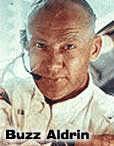
Buzz Aldrin Interview
Scholastic students interviewed Buzz Aldrin, the second man to walk on the moon, on November 17, 1998.Personal History
Did you always want to become an astronaut, even when you were a kid?
I wish I could say that I continually dreamed of space as a career, but it really was not the driving force behind my hopes for the future. As a youngster, I read of Buck Rogers and Flash Gordon. As a student, I wrote English reports on science fiction. And as a fighter pilot, I observed the selection of the Mercury astronauts. All this was fascinating, but I really didn't think I would ever be a part of it. It was only when my good friend Ed White was selected as a Gemini astronaut that I decided to join NASA as part of the Apollo program.
How did your family feel about your becoming an astronaut?
My family has always supported my activities, whether it was doing combat in Korea, flying progressively and challenging fighter-jet aircraft in Europe, or studying for a doctor's degree at MIT. They have been always very supportive and understanding of the challenges and risks involved in my career. A family needs to work as a team, supporting each other's individual aims and aspirations.
Has being famous changed your life?
Totally! With its challenges, difficulties, but unquestionable rewards and opportunities for continued service, being famous has made privacy more cherished. Yet doors of opportunity are more frequent.
Apollo 11 Flight
How did you feel when you found out you were selected to go on the first moon mission?
Neil Armstrong and I were on the backup crew for Apollo 8, and we had trained for that for about six months. Apollo 8 flew to the moon around Christmastime in 1968. It was the first flight to reach the moon and orbit it. It's often remembered for the Christmas message the astronauts on board sent — they read from the Bible while in moon orbit. Then in early January 1969, crews had already been assigned to Apollo 9 and Apollo 10, so it was logical that the backup crew for Apollo 8 would be the primary crew for Apollo 11. This was finally confirmed by the announcement of our selection, with Mike Collins joining our crew in early January. If Apollos 9 and 10 tested the Lunar Lander successfully — first in Earth orbit and then in lunar orbit — then Apollo 11's mission would be to land on the moon. We knew all of this, but we were most relieved when the announcement made it official.
Are you still friends with the other Apollo 11 astronauts, Neil Armstrong and Michael Collins?
Our crew is still closely bonded together because of our fantastic shared experiences. Yet our lives are going in different directions. I always enjoy seeing both Mike Collins, who fishes and paints in Florida, and Neil Armstrong, who conducts his private and business activities from Cincinnati, Ohio. Just recently, I had lunch with Neil and discussed my ideas for reusable rockets. My ShareSpace Foundation is promoting opportunities for private citizens to fly in space on the shuttle, leading toward the next generation of travel, which I feel should be capable of taking 80 to 100 tourists into space. We
also discussed the upcoming 30th anniversaries of all the Apollo flights, especially the potential celebration of Apollo 11 in July 1999.
Why were missions to the moon so important in the late 60s and early 70s?
The leaders of freedom in the world made a commitment to go to the moon because of the conditions of the Cold War. Carrying through on these commitments to reach the moon contributed eventually, I believe, to the end of the Cold War.
Why wasn't a colony ever developed on the moon?
The tools of the Apollo program were not developed for people to live on the moon on a long-term basis. Therefore, economically and politically, they could not be sustained and supported once the original missions had been completed. The rockets and spacecraft of the Saturn 5 and Apollo could have been converted into reusable rockets and spacecraft for the space shuttle in the next generation of spaceflight. Solid rockets and totally disposable external tanks were mistakes, in my opinion.
On the Moon
What did Earth look like from the moon?
From the distance of the moon, Earth was four times the size of a full moon seen from Earth. It was a brilliant jewel in the black velvet sky. Yet it was still at a great distance, considering the challenges of the voyage home.
What did it feel like to walk on the moon? Is its surface different from that of Earth?
The surface of the moon is like nothing here on Earth! It's totally lacking any evidence of life. It has lots of fine, talcum-powderlike dust mixed with a complete variety of pebbles, rocks, and boulders. Many pebbles, fewer rocks, and even fewer boulders naturally make up its surface. The dust is a very fine, overall dark gray. And with no air molecules to separate the dust, it clings together like cement. If you examine it under a microscope, you can see it's made up of
tiny, solidified droplets of vaporized rock resulting from extreme velocity impacts, like an asteroid from outer space hitting the surface over millions of years.
Was being on the moon different than you expected it to be?
I expected the unexpected and went with an open mind. I think the visual scene was described by my words on first landing — "magnificent desolation." Magnificent for the achievement of being there, and desolate for the eons of lifelessness.
How did it feel to be weightless?
There's a tremendously satisfying freedom associated with weightlessness. It's challenging in the absence of traction or leverage, and it requires thoughtful readjustment. I found the experience of weightlessness to be one of the most fun and enjoyable, challenging and rewarding, experiences of spaceflight. Returning to Earth brings with it a great sense of heaviness, and a need for careful movement. In some ways it's not too different from returning from a rocking ocean ship.
Did walking around in the moon's low gravity field feel at all like jumping on a trampoline?
The feeling of reduced gravity and the limitations of the space suit resulted in a slow-motion movement. Perhaps not too far from a trampoline, but without the springiness and instability.
Is it true that a pen saved your life when you and Neil Armstrong tried to lift off from the moon?
Yes, a writing instrument was used to engage the engine arm's circuit breaker, which had broken off after our moonwalk. There were perhaps many other ways of ensuring engine ignition. Liftoff from the moon was obviously essential for our survival, though. I guess that's the master of understatements!
What was the scariest part of being in space?
We really didn't devote a lot of time to investigating the scariest aspects of our flight. It was more challenging and productive to concentrate on the remedies, and leave things that couldn't be solved to happen without thinking about them. There is a morbid human curiosity associated with tragic death-producing events. Though naturally, this needs to be kept in perspective.
John Glenn's Flight
Do you want to go back into space like John Glenn?
Everyone who's been in space would, I'm sure, welcome the opportunity for a return to the exhilarating experiences there. For me, a flight in a shuttle, though most satisfying, would be anticlimactic after my flight to the moon. Plus, if I pursued a flight myself, people would think that was the reason I am trying to generate interest in public spaceflight. And that's not the purpose — I want to generate interest in long-range space exploration.
What do you think John Glenn's mission has accomplished, and what do you think the space program has accomplished for American children?
I think it's sparked a continued rejuvenation of the adventure spirit and pride in achievement for the American people. It's good for children to have heroes other than entertainment and sports figures. However, space careers do not naturally lead to great wealth, as those careers do!
Have you talked to John Glenn since he's returned from space? What did you or will you say to him?
No, I haven't had the opportunity yet, but I expect to renew our friendship soon. We first met during combat in Korea in 1953. I expect to encourage him to support an ongoing, more noble purpose to his flight by opening up space to selected private citizens.
Future Space Exploration
What new efforts in space exploration are you most excited about?
Without a question, Mars is the symbolic and totally stimulating next objective that could so dominate the next century's exploration efforts. From Mars, the resources of all the asteroids will become readily available.
What are the goals of a manned mission to Mars?
When we set out to land people on the surface of Mars, I think we should as a nation, as a world, commit ourselves to supporting a growing settlement and colonization there. To visit a few times and then withdraw would be an unforgivable waste of resources. Logically, I feel we should visit the moons of Mars for several years before journeying to the surface.
Why should we visit the moons of Mars before we visit the surface?
The crews are less at risk on Vovus or Demos (the moons). From there, astronauts can conduct dress-rehearsal landings, make return fuel, and control surface rovers — all far more successfully using the short communication distances from the moons to the surface than the 20–40 minute round-trip communication delays from Earth and back.
Do you think there is life on other planets?
There has been recent evidence of large planets around relatively close stars less than a hundred light-years away. This leads to the speculation that earth-sized moons around such large planets, if located at the appropriate distance from the star, could potentially contain life. Yet thousands or millions of likely situations must be studied to understand the opportunities for life as we know it. I created such situations in my science fiction story, Encounter With Tiber, which was published two years ago and became a TV movie. I would hope for evidence for life within our galaxy and hopefully
closer than a thousand light-years away. We could receive evidence of this within the lifetime of you students. This would be a momentous discovery!
Space Inventions & Artifacts
What devices that were originally invented for use in space are now being used by the public?
Medical monitoring, earth observation, communication and navigation. And, of course, the practical attachments known as Velcro. Tang and Teflon, too, but they're not high on the list.
What souvenirs of your spaceflights have you kept?
I've tried to preserve memories through artifacts and experiences. I hope the government will see fit to reward the lunar travelers with an official sample of the moon rock collection. I don't have any moon rocks now.
What advice do you have for kids who are interested in becoming astronauts?
Youngsters anticipating a career in space should actively read about current space exploration. Astronauts working for the government will always need to be either pilots or mission specialists. Those who want to be pilots should have military experience — ideally, a test pilot background. Mission specialist hopefuls need to demonstrate communication skills and report-writing talents in selected fields of research.
Buzz, do you have any last words for our audience?
Good luck, best wishes, and ad astra (to the stars)!
To continue on your mission, click STS-7 on the star timeline near the top of the page.