





 |
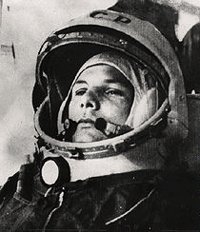
| Russian cosmonaut Yuri Gagarin onboard Vostok 1 (UPI/Corbis/Bettmann) |
 |
| Alan Shepard leaves the Freedom 7 capsule after splashdown. (NASA) |
First Space Flights
NASA had hoped that one of its astronauts would be the first human in space. But on April 12, 1961, the Soviets successfully launch Yuri Gagarin into orbit. He circles Earth in 108 minutes and lands safely.On May 5, 1961, less than a month after Gagarin's flight, the U.S. sends astronaut Alan Shepard into space. His 15-minute sub-orbital flight doesn't impress the Soviets. But it shows that the Americans are still in the race.
In July, astronaut Gus Grissom repeats Shepard's brief hop into space. But after splashdown, his capsule sinks. Grissom almost drowns. Then, in August, a second Soviet flight lasts 25 hours, circles the globe 16 times, and lands safely.
John Glenn, the backup astronaut for both Shepard and Grissom, is scheduled to fly in January 1962. His mission is to circle Earth. If Glenn is successful, the Americans — just like the Soviets — will be able to send warheads anywhere on the planet.
After several delays, John Glenn is awakened at 2:20 a.m. for a planned 7:30 launch on February 20, 1962. He is ready.