




 |
Meet a Super Scientist!
Astronauts aren't born — they go to school and learn about science just like everyone else! Dr. Mae Jemison's curiosity and energy led her to learn about many things. She went to the library and dancing school. She even acted in school plays and was elected to her school government. And even though astronauts are brave, Dr. Jemison had to conquer her own feelings of fear growing up, too, as all children do.Mae Jemison: The First Black Woman Astronaut
It was the first day of school, 1961. Five-year-old Mae Carol Jemison was a confident kindergartner who could already read. When her teacher asked her, "What do you want to be when you grow up?" Mae replied: "A scientist." Her teacher looked surprised: Not many women became scientists then, and certainly few black women. But that was Mae's first and only choice.
Mae's love for science took her to the library. She read books about the universe. She also enjoyed science fiction books. In sixth grade she read Madeline L'Engle's books A Wrinkle in Time and The Arm of the Starfish. "Those books stand out because they had women scientists and girl heroines," Mae remembers.
Books weren't the only way Mae learned. She was active in student government, acted in plays, and studied dance. "In dance class, I grew stronger and gained an appreciation for hard work, physical strength, and grace," she says.
When Mae was 12, there were civil rights demonstrations near her neighborhood in Chicago. To prevent protests before an important political meeting, the mayor of Chicago called in the National Guard, which marched through Mae's mostly African-American neighborhood with rifles. Mae watched, scared, confused, and angry. She promised herself she would never feel that frightened again. "I reminded myself that I was as much a part of this United States as the Guardsmen," she remembers.
In college, Mae studied the physical and social sciences, and learned to speak Russian and the African language Swahili. She earned a degree in chemical engineering and African studies. After college, she studied medicine for four years, and became a medical doctor.
In 1987, Mae was accepted into NASA's astronaut program. She trained in Texas, learning about space exploration. She worked for NASA, and waited for a shuttle assignment.
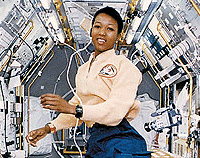
When the space shuttle Endeavour launched into orbit in 1992, Mae became the first African-American woman to orbit the earth. Mae looked down from the shuttle and saw Chicago. She remembered visiting the library, making science fair projects, and dancing. "I felt like I belonged right there in space," she remembers. "I realized I would feel comfortable anywhere in the universe — because I belonged to and was a part of it, as much as any star, planet, asteroid, comet, or nebula."