





 |
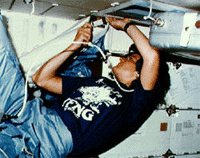
| Sally Ride cleaning out an air-filter system onboard Challenger (NASA) |
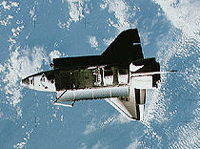 |
| View of Challenger taken from the SPAS satellite (NASA) |
Releasing and Catching Satellites
Soon after the shuttle reaches orbit, Hauck opens the cargo bay doors to expose three satellites.Ride and Fabian open a sunshade protecting the first satellite to be released. Then they start the satellite spinning like a merry-go-round. Spinning will keep it from getting "sunburned" on one side or the other. Then they release the satellite, which fires its own little booster to climb to a higher orbit.
The next day, another satellite is deployed. Dr. Thagard studies the crew's health. Sally Ride can't play tennis, but with stretch cords holding her "down," she runs in place.
On the fifth day of the flight, the last satellite is released. It snaps a picture of the Challenger — the first time a shuttle is photographed while in space. Two hours later, Fabian uses the robotic arm to make the first satellite catch in space. Ride then takes her turn at the controls. She and Fabian release and catch the satellite five times. Crippen declares, "We pick up and deliver."
After six successful days in space, the crew is ready to come home. Because of clouds over Florida's Kennedy Space Center, the craft lands in California. Having traveled more than two and a half million miles, the shuttle touches Earth on Friday, July 24. America's first woman in space is back home in her native state.